Mahjong Connect · Shisen-Sho vs Solitaire
Shisen-Sho vs Mahjong Connect vs Mahjong Solitaire: What's the Difference?
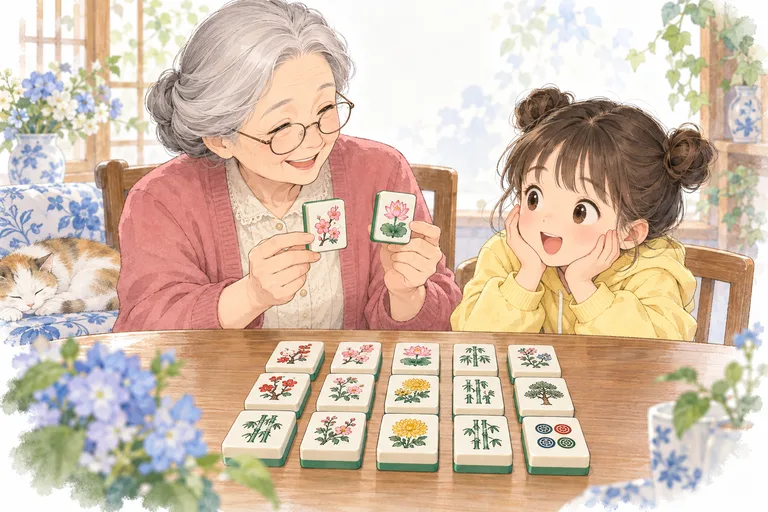
Lots of people playing Mahjong Connect for the first time ask: "Isn't this just Shisen-Sho?" or "Is it the same as Mahjong Solitaire?" All three use mahjong tiles and clear them in matching pairs, but each one has its own twist. Let's sort them out once and for all.
On this page
Shisen-Sho: where it all started
Shisen-Sho (四川省, "Sichuan Province" in Japanese) is a computer game made in Japan in the 1980s. It's named after Sichuan, but it has nothing to do with Sichuan-style mahjong. Its rules are the ones everyone knows today: tiles lie flat, and two matching tiles clear if a line with at most two turns can connect them.
Classic Shisen-Sho uses the full set of 144 tiles in a rectangle of roughly 18 × 8, and seasons and flowers match within their own group. Our large board (16 × 9) is about the same size.
Connect games: same rule, different pictures
Most "connect" or "onet" games you find on phones use the very same rule, just with fruit, animals or gems on the tiles. Some add a timer, levels, or tiles that slide in one direction after a pair is cleared.
Mahjong Connect swaps the pictures back to real mahjong tiles: dots, bamboo, characters, winds, dragons and flowers. Play a few rounds and you'll know your tiles by heart.
Mahjong Solitaire: a stacked-up cousin
Mahjong Solitaire (some people call it Shanghai) looks similar, but the rules are completely different:
- Tiles are stacked in several layers, often in a turtle shape;
- A tile is "free" when nothing sits on top of it and at least its left or right side is open;
- Any two matching free tiles clear, and no line is needed.
So Mahjong Solitaire is about which layer to take apart first, while Mahjong Connect is about how the line can run. If you want the stacked kind, our sister site Mahjong Solitaire has you covered.
Side by side
- Layout: Shisen-Sho and Mahjong Connect use one flat layer; Mahjong Solitaire stacks several.
- What counts as a match: Shisen-Sho and Mahjong Connect need a line with at most two turns; Mahjong Solitaire only checks that both tiles are free.
- Flowers: in all three, seasons are usually one group and flowers another, and any two in a group match.
- Can you get stuck: yes, in all three. Here, every Mahjong Connect board is checked for a solution first, and it reshuffles automatically when you're stuck.
Which rules we use here
Free online Mahjong Connect uses classic Shisen-Sho rules:
- Tiles lie flat and never fall or slide;
- Up to two turns, and the line can go around the outside of the board;
- Spring, Summer, Autumn and Winter are one group; Plum, Orchid, Bamboo and Chrysanthemum are another;
- No moves left means an automatic reshuffle, so you can always clear the board.
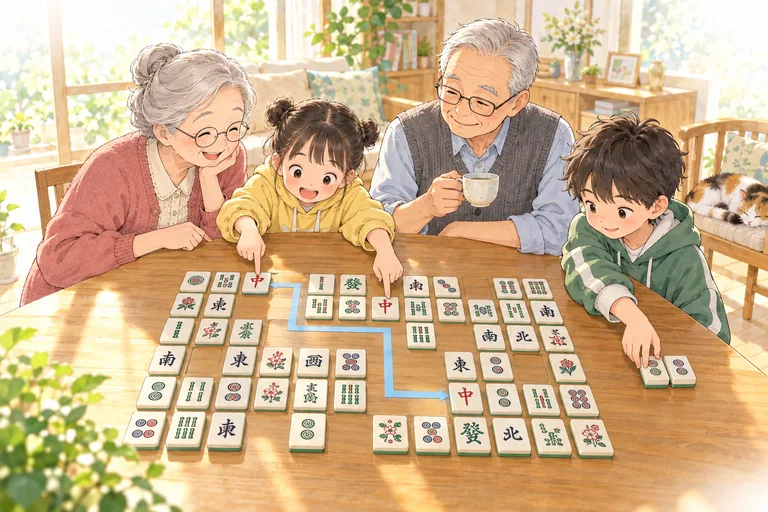
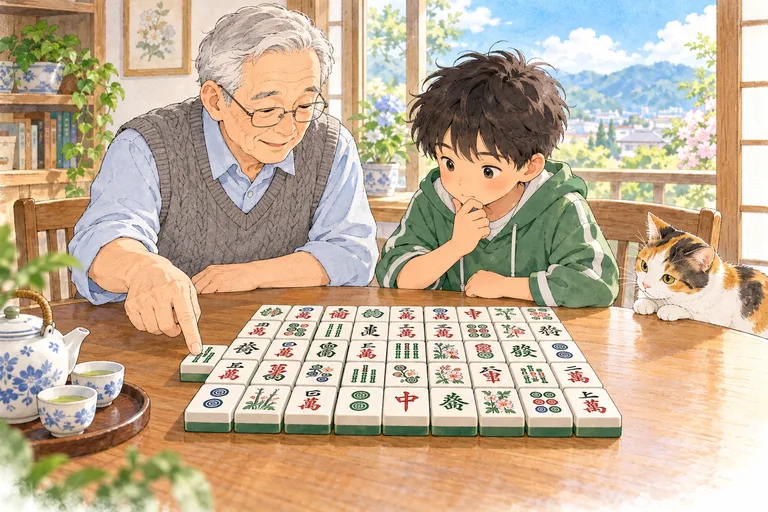
The rules with pictures are in how to play Mahjong Connect, and if you want to get faster, read the Mahjong Connect tips.
FAQ
Is Shisen-Sho related to Sichuan mahjong?
No. Shisen-Sho is the name of a computer matching game. Sichuan mahjong (Bloody Battle) is a real four-player mahjong game. The rules are totally different.
Can a line make three turns?
Not in the classic rules. Two is the max. Some phone versions allow more, but then almost every pair connects, and the puzzle loses its fun.
Which is harder, Mahjong Solitaire or Mahjong Connect?
They're hard in different ways. Solitaire is about planning the order you take tiles off. Connect is about seeing how the line can bend. Try both and see which one you like better.
Keep reading
 How to Play
 Tips
Ready for a round?
Mahjong Connect — Play Mahjong Connect free in your browser: match two identical tiles joined by a line with at most two turns. A new daily board every day, every board solvable, hints and shuffles. No sign-up, phone and desktop.